Chủ Nhật, 7 tháng 12, 2014

How to Melt Chocolate

Chocolate is easy to melt if you use the proper technique. It is also very easy to scorch, turning it crumbly and grainy, and very susceptible to being ruined with the accidental addition of water. Gentle heat, constant vigilance and stirring is the trick. If you have a couple different methods for melting chocolate, give these two a try!
Method 1 of 2: Melt with a Double-Boiler
  1. Melt Chocolate Step 1 Version 3.jpg
    spaceplay / pause
     
    escstop
     
    ffullscreen
    shift + slower / faster (latest Chrome and Safari)
    volume
     
    mmute
    seek
     
     . seek to previous
    126 seek to 10%, 20%, …60%
    1
    Do not add water as the chocolate will become unusable. If you do happen to introduce a bit of water into the chocolate while melting, a little bit of vegetable oil will make the chocolate more usable, although it will still be grainy.
    Ad
  2. Melt Chocolate Step 2 Version 3.jpg
    spaceplay / pause
     
    escstop
     
    ffullscreen
    shift + slower / faster (latest Chrome and Safari)
    volume
     
    mmute
    seek
     
     . seek to previous
    126 seek to 10%, 20%, …60%
    2
    Add the chocolate to top of a double boiler. If you don't have a double boiler, you can easily place a light, non-plastic bowl set over a pot of lightly steaming water. The steam will slowly cook the chocolate above.
    • Make sure not to put the bottom of the bowl (holding the chocolate) in contact with the steaming or boiling water. Contact with the water may cause the bowl to grow too warm, burning the chocolate instead of melting it.
    • The chocolate will melt faster if it is broken up into smaller pieces. Before you do this put the chocolate in a plastic clear bowl over the saucepan which will be over the hob.
  3. Melt Chocolate Step 3 Version 3.jpg
    3
    Stirring constantly, move the chocolate around until it begins to melt. Because chocolate is very easily scalded, be careful not to leave the room or stop stirring for too long.
  4. Melt Chocolate Step 4 Version 3.jpg
    4
    Continue stirring until the chocolate has fully melted. Adjust the heat on the stove if you believe the chocolate is melting too quickly. The whole process should take anywhere from 5 to 10 minutes.
  5. Melt Chocolate Step 5 Version 3.jpg
    5
    Use for recipe for dipping, dressing, or incorporating into another recipe.Again, take care not to accidentally introduce droplets of water to the chocolate with the stirring implement.
  6. Method 2 of 2: Melt with a Microwave
    1. Melt Chocolate Step 6 Version 2.jpg
      1
      Measure out how much chocolate you want to melt. Break up the chocolate into smaller pieces with a knife if the chocolate comes in a block or tablet.
    2. Melt Chocolate Step 7 Version 2.jpg
      2
      Place the desired amount of chocolate into a microwave-safe bowl. Place the bowl into the microwave.
    3. Melt Chocolate Step 8 Version 2.jpg
      3
      Microwave on the lowest heat setting for approximately 30 to 40 seconds. Be sure to change your power setting to the lowest you can before nuking the chocolate.
      • If you are using small chocolate chips, the cooking time on the initial blast will be much lower than 30 seconds. Go in intervals of 10 to 15 seconds initially to make sure that the chocolate chips won't burn.
    4. Melt Chocolate Step 9 Version 2.jpg
      4
      Stir the melted chocolate with a wooden spoon and reintroduce into the microwave for 10 to 15 seconds. Continue to microwave the chocolate on its lowest setting.
    5. Melt Chocolate Step 10 Version 2.jpg
      5
      Stir and repeat microwaving in 10 second bursts until the chocolate is fully melted. Some tips for melting chocolate in the microwave:
      • Dark chocolate is easier to melt than milk chocolate, so use a darker chocolate if you're worried about scorching.
      • A less expensive chocolate might be better suited for your first try at microwaving, in case it's accidentally scorched. Burning a less expensive chocolate is a lot easier on the psyche (and the wallet) than a more expensive one.
      • http://www.wikihow.com/Melt-Chocolate

Everything You Need to Know About Chocolate

n candymaking, chocolate is second only to sugar in importance and frequency of use. Chocolate is unique in that it can be both a fundamental ingredient and a finished candy by itself. Knowing how to handle chocolate, including proper techniques for storing, cutting, melting, and tempering this mercurial substance, can greatly increase your chances of making successful chocolate candies.

What is Chocolate?

Chocolate is derived from the beans of the Theobroma cacao tree, but the substance we know as chocolate is very different from the humble cacao bean. Chocolate must undergo a complex and lengthy process before it becomes the smooth, sweet food we are familiar with. The term "chocolate" can refer to a variety of different products, whose characteristics and taste depends on the ingredients and methods used during processing. Chocolate products can range from small milk chocolate morsels to blocks of unsweetened chocolate to bars of white chocolate, with many different variations.

There are two main rules to handling chocolate: do not let it come into contact with water while melting, and do not put it over direct heat. Water droplets that fall into a pan of melting chocolate will cause it to "seize," or turn into a hard, chunky lump. Similarly, overheating chocolate will ruin the taste and texture of the final product, which is why chocolate should always be melted over indirect heat or in small intervals in a microwave. The following articles will explain how to select and handle chocolate for optimum results.Chocolate is an amazing substance that can be manipulated in remarkable ways, but it must be treated carefully. It is very sensitive to changes in temperature, and care should be taken in its handling and melting to ensure the best texture and taste in the finished product.
  • What is Tempering, and How Do I Do It?
Many chocolate candy recipes call for the chocolate to be "tempered" before use. Tempering refers to a process of heating and cooling the chocolate to specific temperatures so that the cocoa butter in the chocolate forms even crystals. Tempering is not a mysterious or difficult process, but it can take a little practice before it becomes second nature.
Tempered chocolate has a shiny appearance, a hard, crisp snap when broken, and stays stable at room temperature. Chocolate that is out of temper might look streaky or gray on the surface, and have a crumbly or densely chewy texture. Chocolate does not always need to be tempered; for instance, tempering is unnecessary when chocolate will be combined with other ingredients for baking or when being melted for ganache. However, if you are going to be dipping centers in chocolate, or making solid chocolate candies, you will want to temper your chocolate to produce a stable, beautiful, appetizing candy.

http://candy.about.com/od/workingwithchocolate/a/chocolate.htm

A Guide to Chocolate Varieties

Chocolate, as we commonly know it, is the product of a long refining process that begins with the fruit (cacao beans)of the tropical tree Theobroma cacao. The beans are fermented, dried, roasted, and ground, and the resulting products include cocoa butter, a smooth, solid fat used in both food and cosmetics, and chocolate liquor, or ground roasted cocoa beans. The type of chocolate is determined by the various amounts of cocoa butter and chocolate liquor the chocolate contains, as well the amount of sugar and any other ingredients added to the mixture. This brief guide to chocolate terminology will familiarize you with some of the most common chocolate varieties.

  • Cocoa powder:
     This unsweetened powder is pulverized, partially defatted chocolate liquor. Cocoa powder gives an intense chocolate taste and is available in “Dutch-processed” (alkalized) or natural varieties. Natural cocoa powder is light brown, with a strong, pronounced chocolate flavor. It is slightly acidic, so it is best to use natural cocoa powder in recipes calling for baking soda. Alkalized cocoa powder is darker in color, less acidic, and has a milder chocolate taste. Alkalized cocoa powder is recommended for recipes that call for baking powder.
  • Unsweetened chocolate: Also known as “bitter” or “baking” chocolate. This is pure chocolate liquor, composed solely of ground cocoa beans. Although it looks and smells like chocolate, it has a bitter taste and is not meant for consumption on its own—it is best used in cooking, when it can be combined with sugar to make it more palatable. Because cocoa beans contain equal amounts of cocoa butter and cocoa solids, unsweetened chocolate lends a deep, rich chocolate flavor to baked goods. Unsweetened chocolate is the base ingredient in all other forms of chocolate, except white chocolate.
  • Dark chocolate: Chocolate that contains chocolate liquor, sugar, cocoa butter, vanilla and leicithin (an emulsifier).There are no milk solids added in dark chocolate. The cocoa content of commercial dark chocolate bars can range from 30% (sweet dark) to 70- 80% for extremely dark bars. Bittersweet chocolate and semi-sweet chocolate also fall into the “dark chocolate” category.
  • Bittersweet chocolate: Chocolate, as defined by the FDA, that contains at least 35% cocoa solids. Most bittersweet bars contain at least 50% chocolate liquor, with some bars pushing 70-80% chocolate liquor. This chocolate often has a deeper, more bitter flavor than sweet dark or semi-sweet bars. However, the amount of sugar in the chocolate is not regulated, so one manufacturer’s “bittersweet” bar may taste sweeter than another’s “semi-sweet” bar.
  • Semi-sweet chocolate: This is primarily an American term, popularized by Nestle Toll House semi-sweet chocolate chips. Semi-sweet chocolate contains at least 35% cocoa solids, and is generally assumed to be darker than sweet dark chocolate, but sweeter than bittersweet. However, the lack of regulations regarding sugar content means that these classifications are relative and not consistent across brands.
  • Sweet dark chocolate: is “dark chocolate” in the sense that it does not contain milk solids, but it still has a high percentage of sugar and is much sweeter than other types of dark chocolate. Many brands of sweet dark chocolate have only 20-40% cocoa solids.
  • Milk chocolate: In addition to containing cocoa butter and chocolate liquor, milk chocolate contains either condensed milk (most European varieties) or dry milk solids. Milk chocolate must contain at least 10% chocolate liquor (in the United States), 3.39% butterfat, and 12% milk solids. Milk chocolates are typically much sweeter than dark chocolate, and have a lighter color and a less pronounced chocolate taste. Milk chocolate is more difficult to temper properly and more prone to overheating.
  • White chocolate: White chocolate gets its name from the cocoa butter it contains, but does not contain chocolate liquor or any other cocoa products. As a result, it has no pronounced chocolate taste, but commonly tastes like vanilla or other added flavorings. By law, white chocolate must contain a minimum 20% cocoa butter, 14% milk solids, and a maximum of 55% sugar. There are some “white chocolate” products available that contain vegetable fats instead of cocoa butter—these should be avoided from a taste standpoint, as they contain no cocoa products at all, and are not technically white chocolate.
  • Couverture chocolate: Used primarily by professional bakers or confectioners, this chocolate contains a very high percent (at least 30%) of cocoa butter, as well as a high percentage of chocolate liquor. This high ratio makes it expensive, but it also means that the resulting chocolate is smooth and melts quickly and evenly. Couverture chocolate is the preferred chocolate for tempering and enrobing candies. It comes in dark, milk, and white varieties, and can be purchased online or at well-stocked cake decorating stores.
  • Gianduja chocolate: Gianduja is the name given to a European style of chocolate made from chocolate and nut paste. Hazelnut paste is most common, but gianduja can also be made with almond paste. It comes in milk or dark chocolate varieties. Gianduja chocolate can be used as a flavoring or as a substitute for milk or dark chocolate. At room temperature it is soft enough to be rolled or cut, but is too soft to use for molding chocolates.
  • "Candy coating" chocolate: Also known as “confectionery coating,” “summer coating,” or “compound coating.” These terms refer to candy products that are flavored like dark, milk or white chocolate and substitute vegetable or palm oils for cocoa butter. These products are cheaper than most chocolates, and do not contain significant amounts of chocolate liquor; thus, they do not have a strong chocolate flavor or an appealing mouthfeel. However, they have excellent melting and molding properties, and thus are often used in candymaking for dipping or enrobing, since they do not require tempering and can withstand high ambient temperatures. Be careful to never mix candy coating with real chocolate, as the fats are not compatible and the resulting candy will be unattractive and discolored.

Types of cake

    lean yeast bread  

          baguette           

            doughnut          

pancake

sandwitch

croissant

scone

loaf

muffin

pastry

rich yeast bread

pie

cupcake

crepe

cheesecake

pound cake

cake

cookie

chiffon

tart

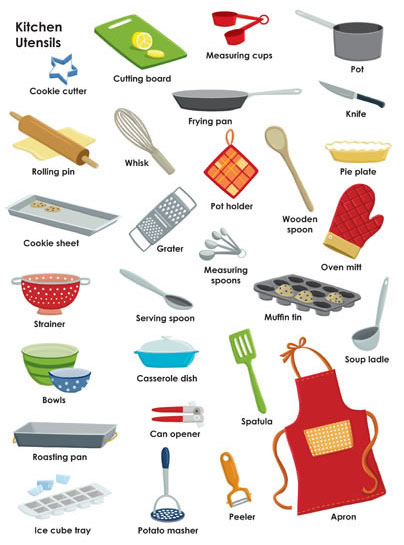
Từ vựng tiếng Anh về đồ dùng nấu ăn


Từ vựng tiếng Anh về đồ dùng nấu ăn
cookie cutter
dụng cụ để tạo hình cho bánh quy
cutting board
cái thớt
measuring cups
li nhỏ để đo lường
measuring spoons
thìa để đo lường
pot
/pɒt/ 
nồi to, dài
rolling pin
trục cán bột
whisk
/wɪsk/ 
dụng cụ đánh trứng
frying pan
chảo rán
knife
/naɪf/ 
dao
cookie sheet
khay đựng bánh quy
grater
/'greitə/
dụng cụ để mài/xát
pot holder
miếng lót nồi
wooden spoon
thìa gỗ
pie plate
dĩa đựng bánh
strainer
/'streinə/
cái rây lọc
serving spoon
thìa canh
muffin fin
khay bánh muffin (một loại bánh mì có nhân trộn cùng với bột và có kích thước nhỏ)
oven mitt(cũng
mitten): găng tay chống nóng
bowl
/bəʊl/ 
tô, chén
casserole dish
nồi hầm
spatula
/ˈspætʃələ/ 
dụng cụ trộn bột (có hình dạng giống chiếc xẻng, có tay cầm, mặt trộn dẹt và to bản dùng để trộn làm bánh)
soup ladle
cái môi (để múc canh)
roasting pan
chảo nướng
can opener
cái mở đồ hộp
ice cube tray
khay đá
potato masher
dụng cụ để nghiền khoai tây
peeler
/ˈpiːlər/ 
dụng cụ bóc vỏ
apron
/'eiprən/
tạp dề


Source: http://leerit.com/hoc-tieng-anh-bang-hinh-anh/tu-vung-ve-do-dung-nau-an/#ixzz3LHwAf5mK
Under Creative Commons License: Attribution Non-Commercial No Derivatives